

Contemporary discussions of war often suffer from a fundamental analytical weakness: the tendency to equate military outcomes with strategic outcomes. Yet the literature in international relations has long demonstrated that the two are not necessarily identical. From Raymond Aron and Hans Morgenthau to Kenneth Waltz, Robert Gilpin, and Barry Buzan, scholars have consistently argued that power is not measured solely by battlefield performance but by a state’s capacity to preserve its core interests, maintain political cohesion, and shape the behavior of other actors over time.
Viewed through this broader lens, Iran presents one of the most intriguing strategic cases of the twenty-first century. Despite decades of sanctions, diplomatic isolation, economic pressure, and regional confrontation, the Islamic Republic remains one of the most influential geopolitical actors in the Middle East
The question, therefore, is not simply whether Iran has endured. The more important question is whether the cumulative effects of recent regional developments are positioning Iran to emerge as a stronger regional power than many anticipated.
Political geography remains one of the most enduring foundations of state power. Classical geopolitical thinkers such as Halford Mackinder, Alfred Mahan, and Nicholas Spykman emphasized that geography often shapes strategic possibilities long before governments formulate policies.
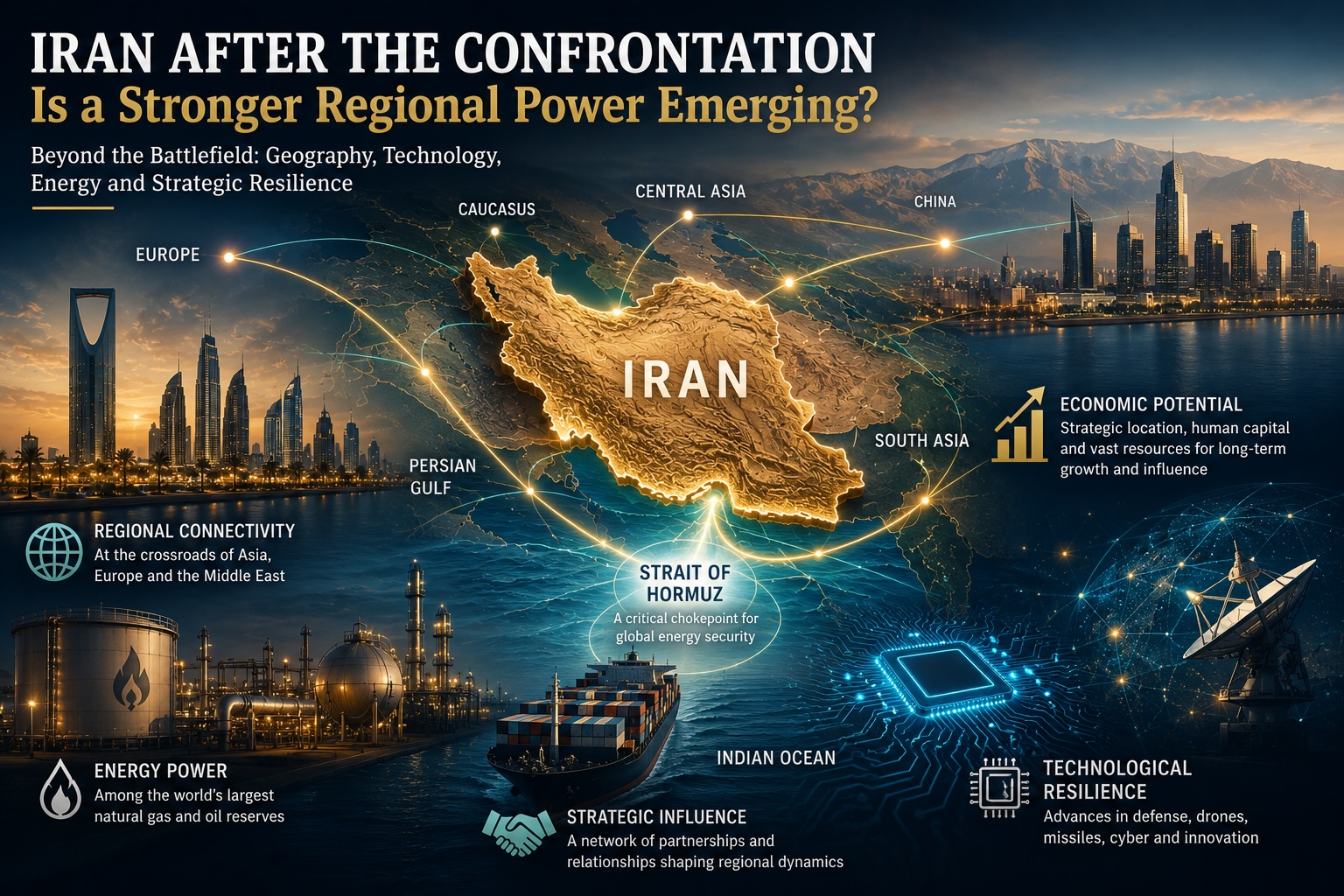
Iran occupies one of the most consequential geographical positions in Eurasia. Located at the intersection of the Persian Gulf, Central Asia, the Caucasus, South Asia, and the Indian Ocean, it sits astride critical commercial and strategic corridors connecting multiple regions.
Most importantly, Iran borders the Strait of Hormuz, one of the world’s most strategically significant maritime chokepoints. A substantial portion of global energy exports from Saudi Arabia, the United Arab Emirates, Kuwait, Qatar, Iraq, and Bahrain passes through this narrow waterway.
Consequently, Iran possesses a structural capacity to influence calculations far beyond its own borders. Even when not exercised directly, this geographical leverage remains an important component of Iranian strategic influence.
Conventional analyses often portray relations between Iran and the Gulf monarchies exclusively through the prism of rivalry. While competition remains undeniable, contemporary international political economy suggests a more nuanced reality.
Saudi Arabia, the United Arab Emirates, Qatar, Oman, Kuwait, and Bahrain increasingly depend upon regional stability to sustain ambitious economic transformation programs. Vision 2030 in Saudi Arabia, the UAE’s diversification strategy, and broader Gulf investment agendas require secure trade routes, predictable energy markets, and reduced geopolitical uncertainty.
This reality has created a strategic paradox. While Gulf states continue to view Iran as a competitor, they simultaneously have strong incentives to avoid prolonged regional instability.
The result is a complex pattern of competition, deterrence, dialogue, and economic pragmatism rather than permanent confrontation.
One of the defining features of Iranian strategy has been its reliance on indirect influence through regional partnerships and networks.
Over several decades, Tehran cultivated relationships with political and military actors across Iraq, Syria, Lebanon, and Yemen. These relationships provided Iran with strategic depth and enabled it to project influence beyond its territorial boundaries.
Several of these partners have faced significant setbacks in recent years. However, research on asymmetric power and network-based influence demonstrates that strategic networks rarely disappear entirely after suffering losses. More often, they adapt, reorganize, and evolve.
The relevant analytical question is therefore not whether these networks have been weakened, but whether they retain sufficient capacity to continue influencing regional calculations.
Economic sanctions are generally designed to constrain state capabilities. Yet political economy research shows that sanctions can also generate unintended effects, particularly when targeted states respond through domestic innovation and strategic adaptation.
Iran represents a notable example of this phenomenon.
Over the past two decades, Tehran has invested heavily in missile development, drone technology, cyber capabilities, indigenous defense production, and scientific research. These investments have created a degree of technological autonomy uncommon among developing economies operating under prolonged sanctions.
While technological self-sufficiency does not eliminate structural economic weaknesses, it does enhance strategic resilience and reduce dependence on external suppliers.
In contemporary geopolitics, technological capacity increasingly functions as a form of power alongside traditional military and economic indicators.
No assessment of Iran’s future position can ignore its extraordinary resource base.
Iran possesses some of the world’s largest natural gas reserves and substantial oil reserves. These resources represent not merely sources of revenue but long-term instruments of geopolitical influence.
Should future diplomatic arrangements facilitate broader reintegration into the global economy, Iran could attract significant foreign investment in energy infrastructure, transportation, telecommunications, manufacturing, and logistics.
Several economic studies suggest that the scale of unrealized economic potential within Iran remains enormous. Under favorable political conditions, the country’s strategic location and resource endowment could transform it into a major commercial and energy hub linking multiple regions.
The significance of this possibility extends far beyond economic growth. Economic integration frequently generates political influence, diplomatic leverage, and enhanced regional standing.
A rigorous analysis must also acknowledge constraints.
Iran continues to face significant structural challenges, including inflationary pressures, financial restrictions, governance difficulties, demographic concerns, and periodic social tensions.
Moreover, regional competitors remain powerful, and international pressure has by no means disappeared.
For these reasons, any claim that Iran has achieved uncontested regional dominance would be analytically unsustainable.
The evidence points instead toward a more nuanced conclusion: Iran remains constrained, but it has not been strategically marginalized.
The central issue is not whether Iran has won or lost a particular confrontation.
The more significant question is whether the Islamic Republic is gradually converting decades of resistance into a more durable form of influence rooted in geography, technology, strategic networks, economic potential, and political resilience.
History suggests that major powers are not defined solely by military victories. They are defined by their ability to survive external pressure, preserve strategic assets, adapt to changing circumstances, and transform constraints into opportunities.
If this interpretation proves correct, future historians may view the current period not as the moment of Iran’s containment, but as a critical stage in the evolution of a more influential regional power.